Envisioning Sustainable Blue Economy in Cities
Smart Water Infrastructure: Treatment Operations & Network Management
Get In TouchKey Insight
Cities that invest now in IoT sensing, smart pump management, and automated distribution monitoring can achieve 30% OPEX reductions and 10–15% energy savings while delivering safer, more reliable water to every resident.
Urban water systems worldwide face a compounding crisis: ageing infrastructure, rising demand, tightening environmental standards, and constrained budgets. This whitepaper makes the case that digitally-enabled smart water technology — applied systematically across treatment and distribution — is the defining lever for cities committed to a Sustainable Blue Economy.
30%
OPEX reduction achievable
10–15%
Energy savings
100%
Real-time network visibility
Deep Dive
The Blue Economy Imperative
Water is the defining resource of the urban era. The Blue Economy concept — sustainable management of water-based systems for economic benefit — demands not only ecological stewardship but the intelligent application of technology across entire water value chains. Legacy infrastructure, built for a different century, cannot meet today's demands for efficiency, transparency, and resilience. IoT connectivity, cloud analytics, and AI-driven automation are converging to offer a transformational alternative.
Smart Water Treatment Operations
Effective water treatment is the first line of defence in delivering safe drinking water. Conventional facilities rely on manual monitoring, scheduled maintenance, and reactive dosing — approaches that are both costly and inherently lagging. Smart Water Treatment transforms these processes through smart pump management, automated chemical dosing, and continuous online analysis with closed-loop automation across every treatment stage.
Smart Water Network Management
Once water leaves the treatment facility, it enters a complex distribution network where leakage, pressure imbalances, and quality degradation pose continuous challenges. Smart Network Management provides cities with total real-time visibility and control — from intelligent softeners with demand-responsive regeneration to interconnected IoT nodes that create a live, data-rich picture of network performance.
Implementation Pathway
Transitioning to smart water infrastructure benefits from a phased, risk-managed approach. Phase 1 deploys IoT sensor platforms and establishes cloud analytics. Phase 2 activates predictive maintenance and automated dosing. Phase 3 uses data feedback loops to continuously refine operations and expand sensor coverage. Cities that act decisively will unlock immediate gains while building infrastructure for decades ahead.
Part I — Smart Water Treatment
Smart Pump Management & Automated Chemical Dosing
Tandem OT Integration
No rip-and-replace required — integrates directly with existing PLC and SCADA systems.
Multi-Pump Coordination
Optimised cycle management across multiple pumps to balance load and reduce wear.
Predictive Failure Detection
Machine learning on vibration, pressure, temperature, and flow sensor history flags issues before they cause downtime.
Real-Time Mobile Alerts
Automatic notifications delivered to operator devices for rapid response — from anywhere.
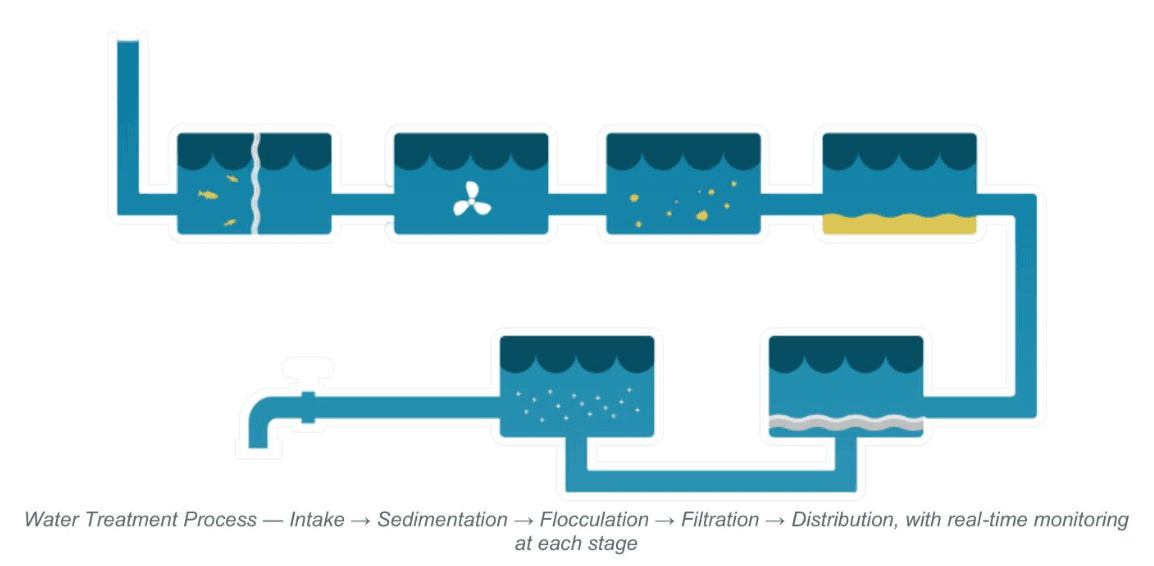
Water Treatment Process — Intake → Sedimentation → Flocculation → Filtration → Distribution, with real-time monitoring at each stage
Treatment Process Flow
Intake
Sedimentation
Flocculation
Filtration
Distribution
Smart Pump vs Smart Treatment
⚙️ Smart Pump Management
- Integrates with existing OT/PLC
- Vibration, pressure, temp, flow sensing
- Predictive failure detection
- Multi-pump cycle optimisation
- Mobile alerts to operators
🧪 Smart Water Treatment
- Online pH, turbidity, DO, TDS monitoring
- Automated chemical dosing
- 30% OPEX reduction via remote staffing
- Coordinated multi-stage treatment
- Remote chemist oversight
Part II — Smart Water Network
Smart Softeners, Leak Detection & Distribution Transparency
Real-Time Leak Detection
Precise geographic location of leaks using hydraulic anomaly detection across the sensor network.
Automated Meter Reading
Eliminates manual reading labour costs and enables accurate, real-time consumption tracking.
Demand Forecasting
ML-powered capacity planning that predicts demand patterns and enables proactive resource allocation.
Optimal Pressure Management
Reduces burst risk and eliminates over-pressurisation, delivering 10–15% energy savings.
Key Outcomes
Cost
30% OPEX reduction via remote monitoring and automation
Energy
10–15% savings through pressure optimisation
Visibility
100% real-time transparency across the entire network
Implementation Roadmap
Foundation: Connect & Sense
- • Deploy IoT sensor platforms at treatment plants and key network nodes
- • Establish secure data communication networks and cloud analytics infrastructure
- • Integrate smart pump management with existing PLC and SCADA systems
- • Commission Central Control Room dashboards for real-time monitoring
Intelligence: Analyse & Automate
- • Activate predictive maintenance algorithms on pump and asset telemetry
- • Enable automated chemical dosing based on continuous quality analysis
- • Deploy demand-responsive regeneration in smart softener systems
- • Implement leak detection and demand forecasting analytics across the network
Optimisation: Continuously Improve
- • Use data feedback loops to refine dosing, scheduling, and pressure management
- • Feed manufacturer insights for equipment improvement and remote support
- • Expand sensor coverage and integrate additional quality parameters over time
- • Publish performance data to support regulatory reporting and public accountability
Sustantix Team
Knowledge Series · Smart Water Infrastructure
Building your city's smart water roadmap?
We help water authorities design phased implementation pathways for IoT-enabled water infrastructure.